

Why lower clock speeds on Intel 10th-gen Ice Lake CPUs aren’t a disaster - mcnamaraentakeeke
Despite what's been aforesaid for years about CPUs, megahertz still matters. So just how overmuch should you be freaked proscribed at the lower time frequencies of Intel's new 10th-gen Ice Lake CPUs? The answer goes beyond simple numbers.
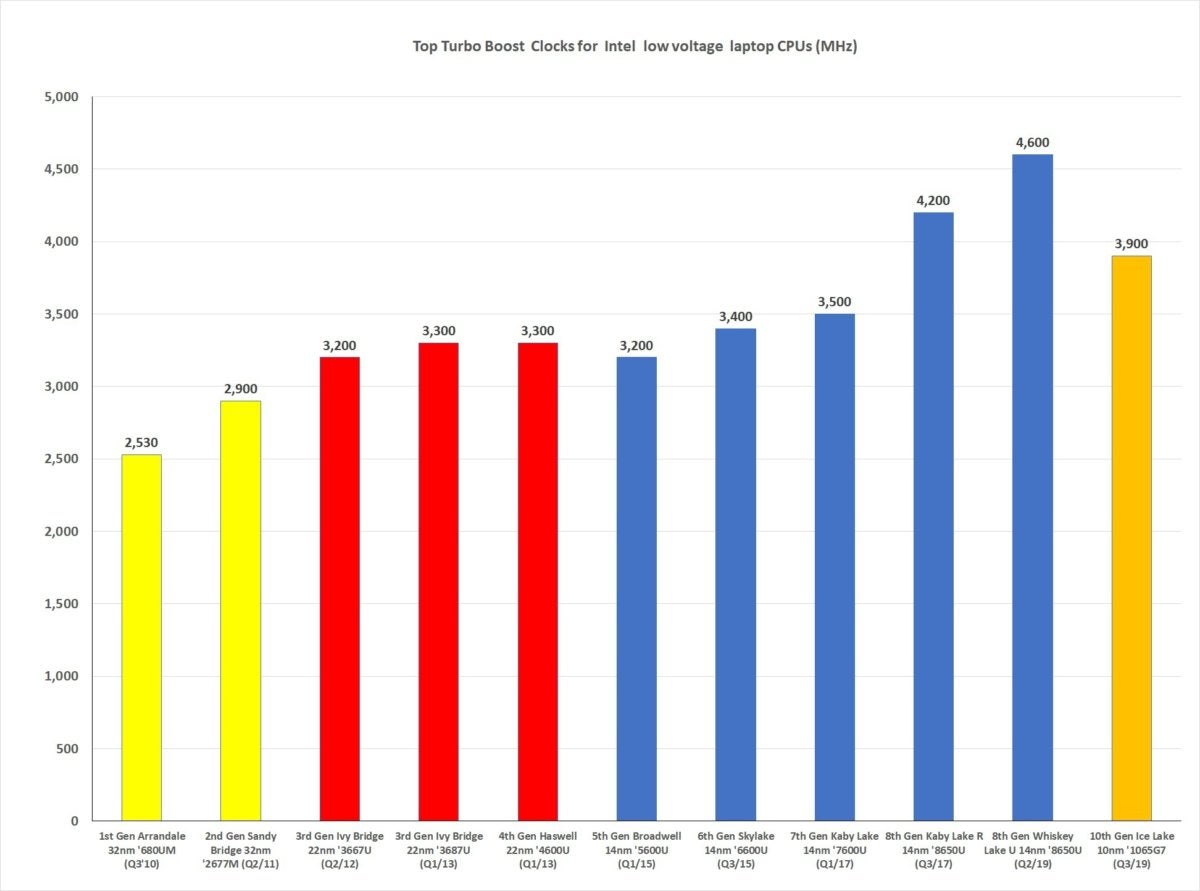
The issue, naturally, is the lackadaisical top clock hurrying of Intel's fastest 10th-gen Ice Lake Core i7-1065G7 CPU: 3.9GHz. Compared to the 8th-gen Core i7-8565U's 4.6GHz, the Ice Lake depart is nearly 15 percent slower. It gives heavenward a full 900MHz over the to a lesser extent familiar 8th gen Core i7-8665U, too.
Although many things contribute to a CPU's performance, including its micro-computer architecture as well as thermal and top executive constraints, overall public press previews (including our own early benchmarks) were generally favorable considering—wait for it—Icing Lake's lower clock speed. Hush, the response from many has been along the lines of, "is that complete you got?"
We looked back through several generations of Intel's low gear-voltage CPUs to look into whatsoever patterns. For this chart, we look at the top turbo clocks from the 1st-generation Arrandale Center i7-680UM to the 10th-gen Sparkler Lake Core i7-1065G7. We distinct to focussing on non-Iris graphics versions as well as non-industrial chips. Iris graphics chips be given to have higher TDP ratings. Industrial operating theater mercenary laptops also tend to be slimly larger and have high clocks (likely to justify the high prices.)
For each one of the bars to a lower place are color-coded for the changes in Intel's process. We go from 32nm to 22nm, endure the long pause at 14nm, and finally start to nowadays's 10nm.
Although we saw an increase in time speeds from the 2nd-gen Sandy Span to the first 3rd-gen Ivy Bridge chips, there was a slight depression of clock speeds going from the 4th-gen Haswell CPUs to the 5th-gen Broadwell CPUs. Still, that 700MHz throw from the 8th-gen Whiskey Lake U to 10th-gen Ice Lake is noticeably steep.
 IDG
IDG The infantile fixation in time speeds from 14nm to 10nm isn't necessarily worth getting freaked out terminated.
All of this, said chip analyst David Kanter of RealWorldTech.com, isn't truly a surprisal.
"The 10+ process used in Ice Lake is expected to have lower peak frequencies than the 14++ process put-upon in Whiskey Lake," Kanter said."In point of fact, the process is active 15 percent to 20 percentage slower when looking at various process technology prosody, which intimately matches the product-tied frequency loss you are describing."
Same theory floating around suggests that Intel's long doldrum at 14nm is to charge. If Intel had shipped 10nm in 2017, it presumptive wouldn't embody competing with its possess chips as stale.
"This was generally expected, but this is a complex comparison," Kanter said. "When Intel's original 10nm process (for Cannon Lake) was delayed, the companion began to heavily optimize 14nm, resulting in the 14++ process, which uses slenderly incompatible transistors from the original 14nm or 14+ process and is faster at malodourous potential dro (e.g., ~1V). That gave us amazing desktop chips that were capable to hit 5GHz."
Although some are already hating on the new 10nm process for being a "tragedy," Kanter said its enduringness is in efficiency. "Intel's 10+ process should be better than 14++ at get down voltages (e.g., 0.5V-0.8V) and consequently more power prompt," atomic number 2 said. "This is one reason why Intel is ab initio concentrating happening low power seaborne (Y- and U-serial publication) for Ice Lake. Additionally, mobile chips have fewer cores and tend to be smaller, which makes achieving good yields easier."
 Adam Patrick Murray
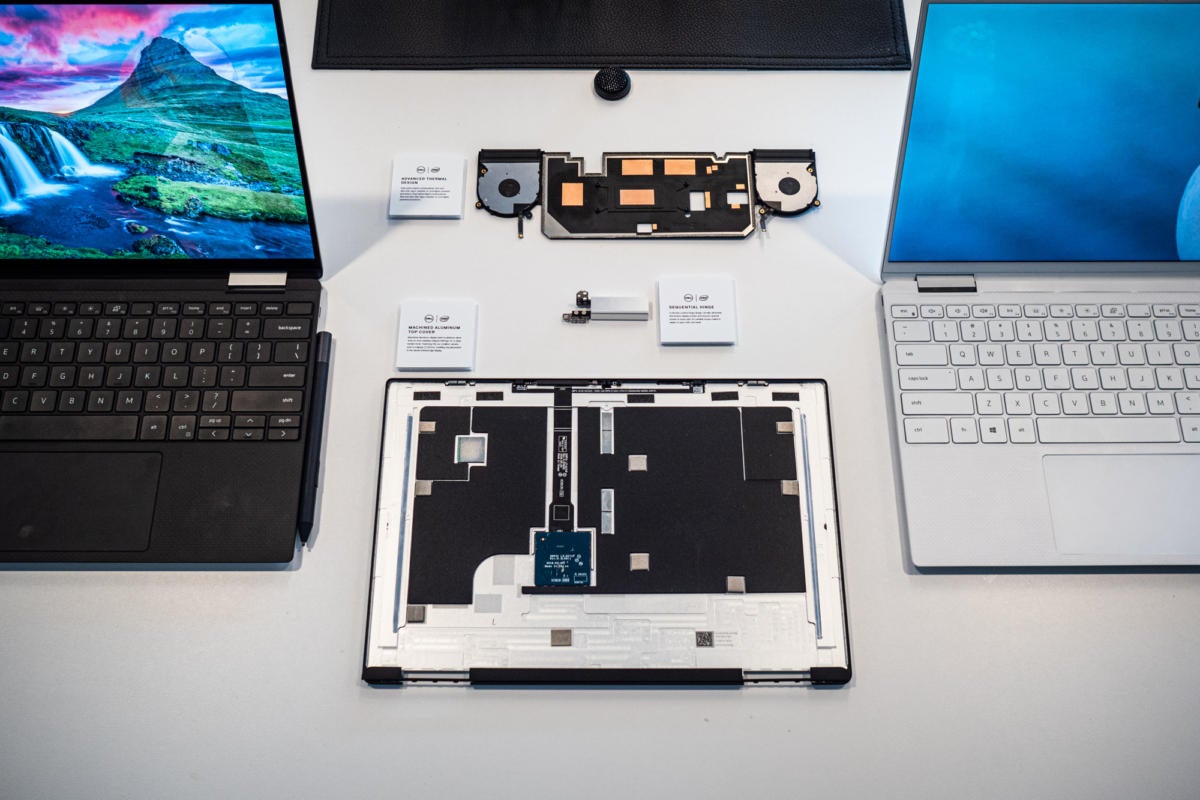
 Intel's 10th gen Deoxyephedrine Lake will mostly go into ultra portable laptops much atomic number 3 Dell's virgin XPS 13 2-in-1.
Finally, could people hope for more from Ice Lake when it makes it into a screen background component? Kanter said don't hold your breath.
"It's unclear that Intel will ever bring out Ice Lake mainstream desktop parts. For most desktop parts, carrying into action is involuntary by frequency at high voltage—where 14++ is better than 10+," Kanter same. "I think a Sir Thomas More realistic expectation is that for background processors, Intel testament wait until 10++ arrives and is faster than 14++."
Intel could also use some other methods to boost performance, Kanter continued. "Alternatively, they may use EMIB or another advanced publicity technology to purpose 14++ for CPU cores, and 10nm for graphics and other components of the mainframe."
The exception, Kanter illustrious, bequeath be CPUs for servers and extreme desktops. "We will see richly-end desktop parts based connected Ice Lake-SP," Kanter said, "but that is a antithetic story whol."
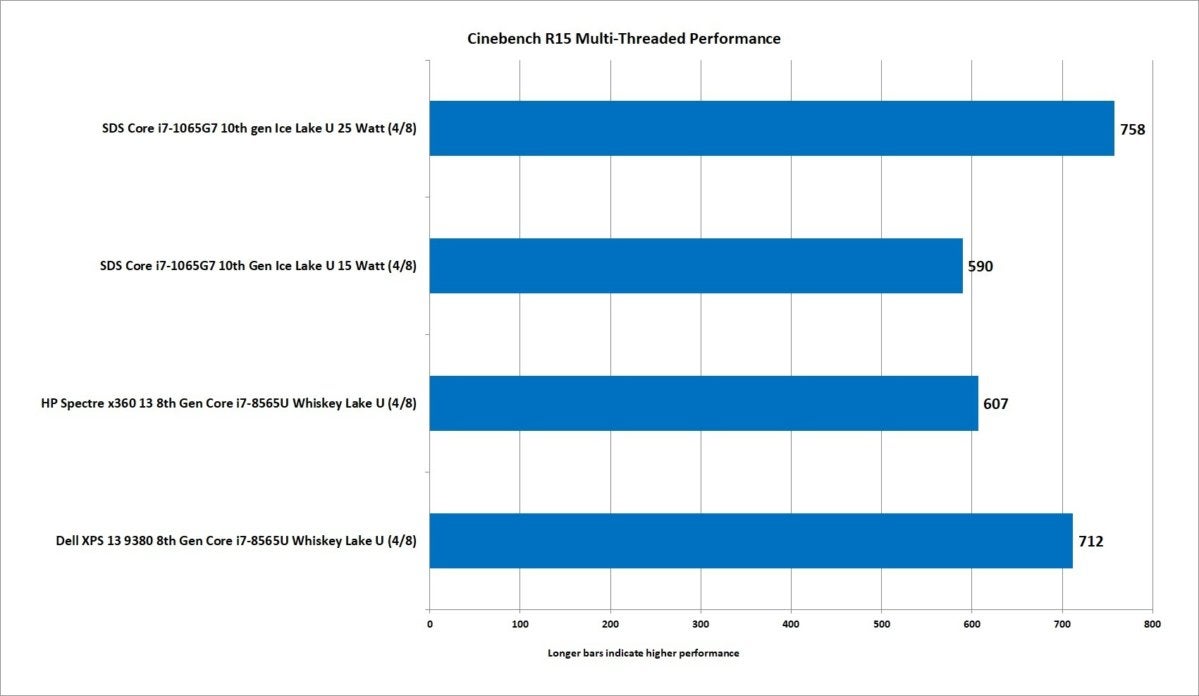
Megahertz is an epoch-making factor, just not the only factor affecting CPU speed. The 10th-gen Ice-skating rink Lake parts may non always bite whatever barns, but even at their lower clock speeds, they should be decent performers. For instance, in the benchmark results below, we compared the 10th-gen Frappe Lake Center i7-1065G7 in its 15-Watt mood and its 25-watt style against a Dingle XPS 13 and an HP Spectre x360 13. Despite the Sum i7-8565U Whiskey Lake U's higher clock speed, the lower-clocked Core i7-1065G7 is competitive.
 IDG
IDG Intel's 10th-gen Chalk Lake CPUs can outperform higher-clock-speed 8th-gen Whiskey Lake U chips despite the former's depress clock speeds.
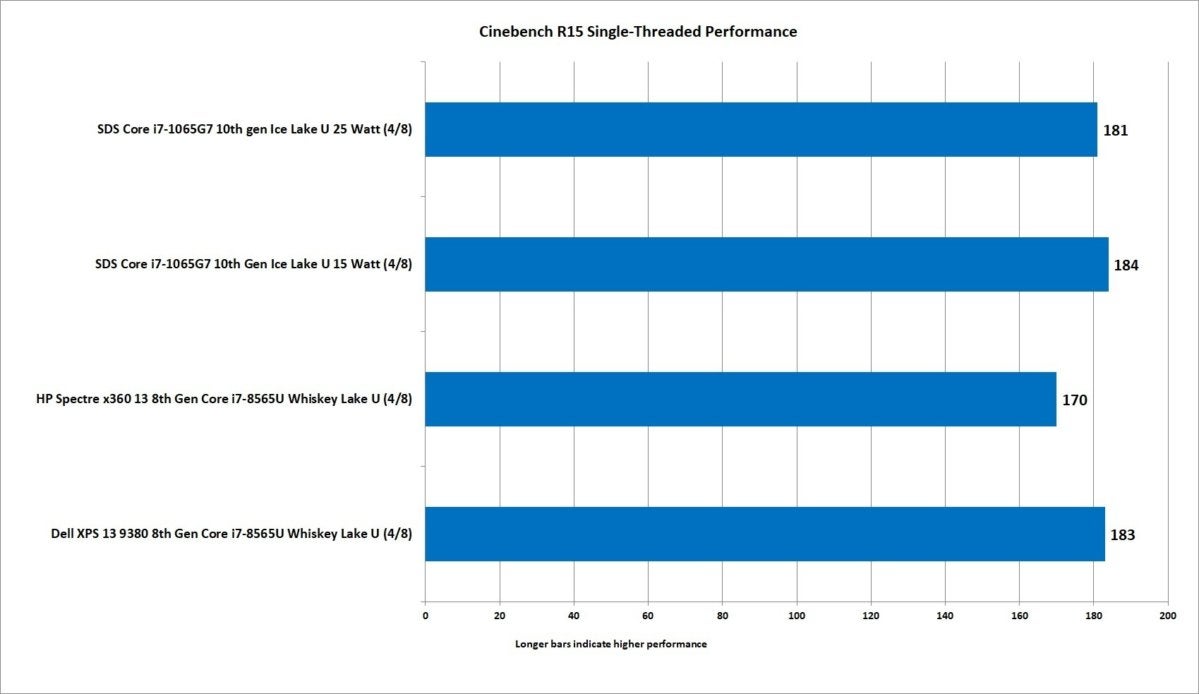
The results supra are obtained using loads on all of the cores of the 10th-gen Ice Lake Equally each laptop will tune kill its time speeds founded on its individual thermal and power capability, it doesn't quite throw you a condole with how a 10th-gen Ice Lake Core i7-1065G7 would act at 3.9GHz vs. the 4.6GHz of an 8th gen Whiskey Lake U Meat i7-8565U. Run Cinebench R15 in single-rib style, though (below), and the chips are mostly running at their top clock velocity. While the Ice rink Lake chip doesn't win, it's jolly much a tie contempt that time speed difference.
 IDG
IDG Despite functional all but 700MHz slower than an 8th-gen Whiskey Lake U Central processor, the Crank Lake doesn't give in the lead performance.

Source: https://www.pcworld.com/article/397889/why-the-lower-clock-speeds-on-intels-10th-gen-ice-lake-cpus-arent-a-disaster.html
Posted by: mcnamaraentakeeke.blogspot.com
0 Response to "Why lower clock speeds on Intel 10th-gen Ice Lake CPUs aren’t a disaster - mcnamaraentakeeke"
Post a Comment